
The Deaths We Choose to See
How the attention economy turns human suffering into moral currency
Outrage has become one of the dominant forms of public participation. It arrives through petitions, parliamentary statements, social-media posts, public demonstrations and open letters to ministers. Much of it begins in the right place. People see suffering, refuse to look away and demand that governments do something about it.
Governments should be challenged. Atrocities should be exposed and legal obligations tested. Silence can protect the people causing harm. But public concern can also become something else. The expression of outrage begins to matter more than the people on whose behalf it is expressed.
We have all seen the pattern. A minister acknowledges terrible suffering but does not use the approved language, so the acknowledgement is dismissed as hypocrisy. A government takes one step and is accused of creating a cynical distraction from all the steps it has not taken. Activists, writers, actors and musicians compete to make the most absolute declaration. An allegation is repeated as though a court has already settled it. Anyone asking for evidence or context is treated as though they lack compassion.
Gaza is now the clearest example. Palestinian civilians have endured death, displacement, hunger and destruction on a horrifying scale. Israeli conduct should be investigated rigorously, unlawful actions prosecuted and British policy scrutinised. We can say all of that without pretending every allegation has already been proven. We can condemn a government without condemning an entire people. And we can try to understand why something happened without excusing it.
The difficulty begins when one conflict becomes the overriding test of whether somebody possesses a conscience. Compassion then becomes a signal. It tells other people who we are, where we belong and which side of a perceived moral boundary we occupy. The dead remain central to the language, but the performance is increasingly about the living.
The anatomy of moral certainty
Hollow outrage has a recognisable structure. It is not enough to acknowledge suffering or support action. The right words must be used, the complete explanation accepted and the approved enemy condemned without qualification. Sympathy that falls short is dismissed as fake.
Legal language is often asked to carry more than the law has established. Provisional measures, findings about plausible rights, prosecutors' applications, arrest warrants and final judgements are not the same thing. Genocide, apartheid, ethnic cleansing and complicity have precise meanings as well as enormous moral force. Using them accurately matters. If they become badges of social and political belonging, we weaken the institutions needed to establish responsibility.
Partial action is treated in much the same way. Sanctions can restrict money, trade and movement; consumer boycotts and divestment campaigns can alter behaviour or signal public pressure. Some measures have real effect and others are largely symbolic. They should be judged by what they change. Instead, governments are condemned for doing nothing and then, when they act, the action itself is dismissed as a cynical distraction because it falls short of the campaigner's complete demand.
Distinctions are also flattened. Support for Israel's existence and security becomes support for everything its government does. Support for Palestinian freedom becomes support for Hamas. We do not reason this way elsewhere. We can support Ukraine without endorsing every Ukrainian decision, oppose the Iranian regime without opposing Iranians, and care about Britain without approving its government. Israel should not be protected from scrutiny. It should not be denied distinctions allowed to every other country either.
Facts that complicate the preferred story are then treated as excuses. The hostages, Hamas, Iranian support for armed groups, regional deterrence and the consequences of sanctions or arms restrictions do not excuse unlawful conduct. They are part of the reality within which it has to be stopped. A position that cannot hold more than one truth may attract applause, but it is unlikely to produce a workable peace. As we shall see, the same intolerance of complexity helps determine which tragedies receive attention at all.
The deaths we organise ourselves to see
If public attention followed human suffering alone, its distribution would look very different. The examples below are not a league table. The figures cover different periods and measure different things. Some are verified direct killings; others are estimates that include deaths from hunger, disease or the collapse of essential services. They cannot responsibly be added together or used to determine which tragedy should matter most. They do, however, reveal the scale of suffering that can remain peripheral to Western political identity.
| Crisis | Indicative human toll | What the figure means |
|---|---|---|
| Gaza and Israel | More than 73,000 Palestinians reported killed in Gaza since October 2023, alongside about 1,200 people killed in the Hamas-led attack on Israel. | The Gaza figure is reported by the territory's health ministry and used by UN agencies; it does not consistently distinguish civilians from combatants. Israeli civilians, soldiers and foreign nationals were among those killed on 7 October. |
| Syria | 306,887 civilians estimated by the UN to have been killed directly between March 2011 and March 2021. | A conservative estimate excluding combatants and indirect deaths. Multiple state and non-state actors were responsible. |
| Yemen | 377,000 conflict-related deaths estimated by UNDP by the end of 2021; nearly 60 per cent were indirect. | UNDP estimated that 70 per cent were children under five. This is a modelled toll, not a list of people directly killed. |
| Sudan | At least 59,000 people reported killed since war began in April 2023; the true toll is likely much higher. | More than 14 million people have been displaced. The Sudanese armed forces, the RSF and their external supporters are implicated in different abuses. |
| Eastern Congo | Approximately 7,000 people reportedly killed during the M23 escalation between January and late February 2025. | A Congolese government estimate amid fragmented fighting involving M23, state forces and numerous armed groups. |
| Somalia | 43,000 excess deaths estimated during the 2022 drought. | Approximately half were children under five. Drought interacted with conflict, displacement, insecurity and inadequate access to aid; these were not all direct killings. |
| Afghanistan | 46,319 civilian deaths estimated during the post-2001 war. | A direct-war-death estimate. Responsibility included the Taliban and other armed groups, Afghan forces and international forces. |
| Myanmar | More than 8,000 civilians and pro-democracy activists verified as killed by the military since the February 2021 coup. | The Assistance Association for Political Prisoners describes this as a minimum verified total. Conflict deaths involving all parties are higher. |
| Iran | At least 3,919 deaths verified during the protests that began in December 2025; an Iranian official acknowledged at least 5,000. | The official total included about 500 security personnel. The UN fact-finding mission found reasonable grounds to believe the crackdown involved crimes against humanity. |
The figures are placed beside one another not to rank grief, but to expose the extraordinary inequality of our attention.
That is precisely the point. The numbers cover different periods, causes, perpetrators and evidential limits. Some count people killed by violence. Others estimate people who died when food, medicine and essential services disappeared. Yet one conflict can be presented with absolute moral certainty while another fades into complexity, distance and silence.
Gaza does not receive attention merely because many civilians have been killed. Syria, Yemen and Sudan show that scale alone cannot explain the response. Nor is it simply the vulnerability of the victims. UNDP estimated that hundreds of thousands of children under five died through the consequences of the war in Yemen without their deaths becoming a recurring test of every British public figure's moral legitimacy.
Gaza does not receive too much compassion. Syria, Yemen, Sudan, Congo and the others receive too little. That difference cannot be explained by suffering alone. It shows that compassion is being distributed through a system responding to something other than human need.
Why some tragedies travel
Some tragedies are easier to understand, easier to turn into a political story and easier to use as proof of what kind of person we are. Responsibility can be assigned to a familiar government, Western policy is close enough for accusations of complicity to carry force, and the images are immediate. The conflict can be presented as a simple relationship between oppressor and victim.
That simplicity has political and social value. It gathers followers, consolidates audiences and mobilises votes. It allows a politician, campaigner or public figure to take a position people immediately recognise. The position then becomes part of an identity: evidence that the speaker belongs to the right group and sees the world in the right way.
Other tragedies do not fit so neatly. Eastern Congo contains a shifting network of armed groups, neighbouring governments, mineral interests and historic grievances. There is no single villain and no single policy that promises resolution. In Yemen, people were killed by bombs and battlefield violence, but many more died slowly as food, medicine and public systems disappeared. Afghanistan implicates the Taliban, Western forces, the former Afghan government and the consequences of two decades of policy. Somalia combines armed conflict, weak institutions, climatic shocks and restricted humanitarian access.
Complexity should make us look more closely. In the attention economy, it often makes us look away. A tragedy requiring five paragraphs of explanation travels badly beside one that can be turned into a slogan, flag or declaration of allegiance.
Personal connection matters too. Jewish, Muslim, Israeli and Palestinian communities understandably experience this conflict with an immediacy that others do not. Historical responsibility and Britain's role in the region are relevant. But these factors explain only part of the intensity. They do not explain why increasingly absolute positions are rewarded, why evidential caution is treated as moral failure or why condemnation so often becomes more socially valuable than understanding.
Antisemitism is also part of the cultural machinery, though it does not explain every criticism of Israel and should never be invoked to protect a government from scrutiny. It becomes visible when the Israeli government becomes 'the Jews', when Jewish people elsewhere are expected to answer for it, or when old ideas about Jewish influence return in modern language. It is also present when every Israeli is treated as an agent of the state while distinctions between people and government are preserved everywhere else.
An account of Israel's singular place in the Western moral imagination is therefore incomplete if it refuses even to look for antisemitism. But calling every critic antisemitic would be another way of avoiding the evidence. The standard has to work in both directions.
The moral attention loop
In the earlier essay Change the Signal, we argued that systems do not require bad people to produce bad outcomes. They require incomplete signals, repeated often enough. The attention economy provides an unusually clear example.
Social-media platforms reward engagement. Campaigning organisations require mobilisation. Journalists need stories that can be understood and transmitted. Politicians must respond to visible pressure. Public figures are encouraged to demonstrate that they stand on the correct side of a perceived moral boundary. Audiences receive both information and a means of expressing who they are.
Each response is understandable. Together they form a feedback loop.
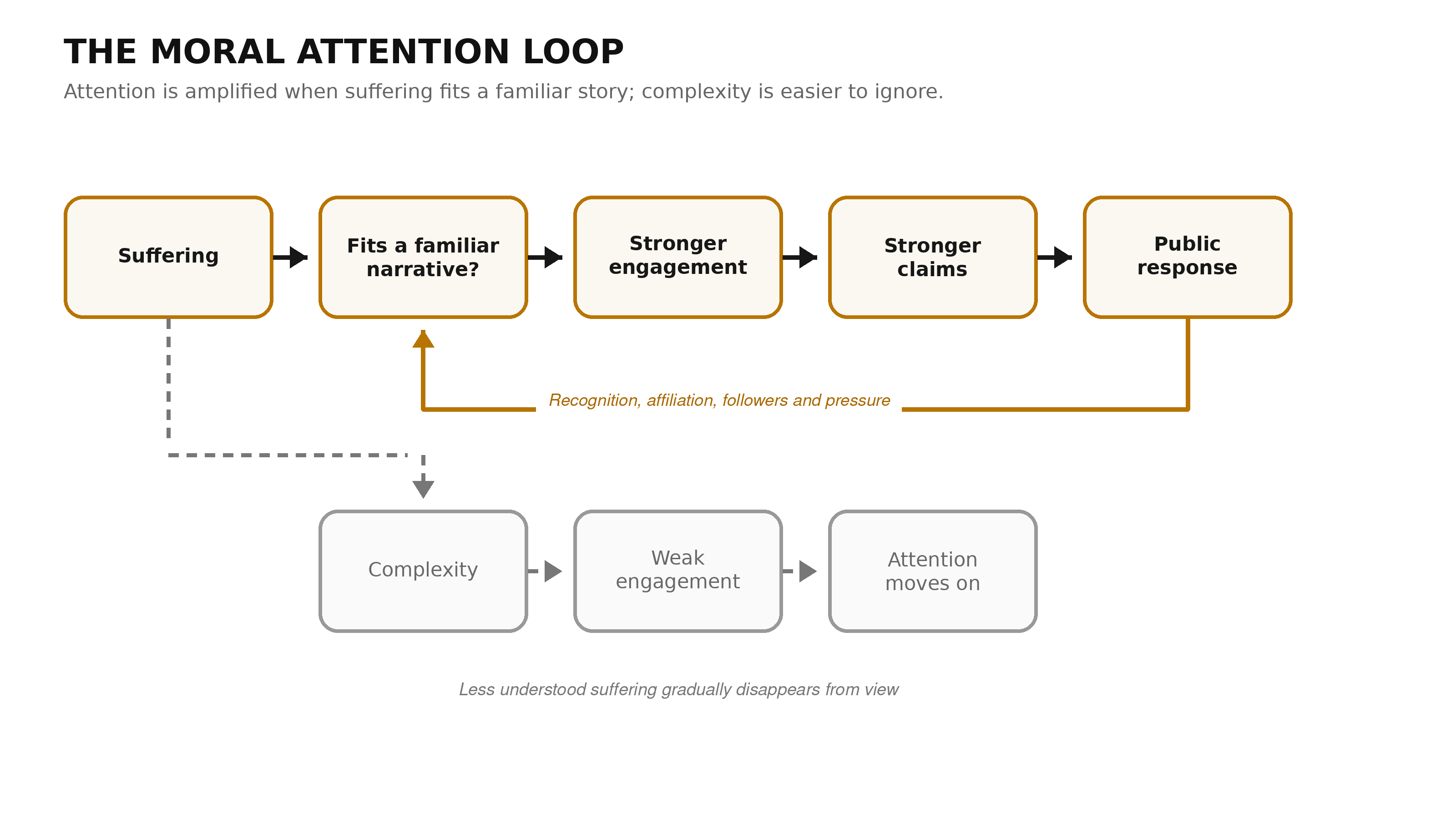
Figure 1: The moral attention loop
Civilian suffering enters a system looking for a story it already understands. When the suffering fits a familiar narrative, engagement signals demand for more of the same. Stronger claims travel further, political and media responses validate the original selection, and the loop begins again. Recognition, affiliation, followers and pressure all reinforce it.
Different people are drawn to the conflict for different reasons. Some see a struggle for Palestinian freedom. Others see Western complicity, colonial history, racial injustice or a religious and historical obligation. Antisemitism can also direct attention towards Israel, particularly when criticism of its government slips into older suspicions about Jews collectively.
These motives are not equivalent, but they concentrate attention on the same conflict and help reward increasingly absolute positions around it.
Suffering that does not fit a familiar story follows the lower path. Complexity produces weak engagement. Weak engagement produces less coverage and less political pressure. The people do not matter less, but they gradually disappear from view.
No editor, campaigner, politician or social-media user needs to decide that one dead child matters more than another. Participants follow the signal immediately in front of them. The aggregate outcome is nevertheless a hierarchy of visibility.
This is the same structural problem appearing elsewhere in the SIGNALS collection. GDP can mistake economic activity for progress. Financial markets can mistake rising claims for productive capacity. Social media can mistake attention for importance. Moral discourse can mistake rhetorical intensity for truth. In each case, the measure begins to displace the thing it was supposed to reveal.
When suffering becomes moral currency
Once outrage brings approval, the incentive is no longer merely to care. It is to care more visibly, speak more absolutely and condemn more fiercely than the next person. A partial response becomes proof of evasion. A distinction becomes an excuse and uncertainty becomes cowardice.
Politicians should be held accountable for the decisions within their control: arms licences, diplomatic support, sanctions, aid and recognition. But much of the rhetoric skips that chain of responsibility. A minister is declared personally complicit because they used the wrong phrase, rejected the most absolute allegation or failed to adopt the campaigner's complete programme. Which decision enabled which harm, what alternative was available and whether it would have changed the outcome are rarely explained. Accountability becomes accusation, and accusation becomes another way for the speaker to demonstrate moral superiority.
Palestinians themselves are diminished by this performance. People with different politics, histories, families and aspirations are flattened into a single moral symbol. Israeli civilians are treated in much the same way, appearing either as extensions of their government or as inconvenient qualifications to a cleaner story. Human beings become evidence for positions formed elsewhere.
That is how death becomes a popularity contest. Not because anyone openly declares that one life possesses greater value, but because some deaths generate recognition, affiliation and applause while others generate little more than a passing headline.
Balance is not equivalence
The answer is not an empty both-sidesism. Balance does not mean pretending that power, conduct and responsibility are always equal. Evidence may show that one party caused more harm, violated more obligations or possessed far greater capacity to avoid civilian deaths. Consistency requires us to say so.
Balance means applying the same standards even when they produce unequal conclusions. It means distinguishing combatants from civilians and governments from populations. It means testing claims against evidence, using legal terms according to their legal meaning and acknowledging uncertainty where uncertainty exists. It means condemning unlawful Israeli conduct without laundering the crimes or intentions of Hamas, and recognising Palestinian suffering without erasing Israeli suffering.
It also means extending the same curiosity and moral concern to people whose deaths provide less political currency. The Syrian child killed by a barrel bomb, the Yemeni child lost when food and medicine disappeared, the Congolese family caught between armed groups, the Afghan civilian killed by a Taliban bomb or Western airstrike, and the Iranian teenager shot for demanding freedom do not matter less because their stories are harder to organise into our politics.
Human beings will always feel particular connections to particular places. Attention cannot be divided mathematically, and compassion need not be perfectly symmetrical. But standards can be consistent. The willingness to examine our allies should be matched by a willingness to examine their enemies. Civilian protection should not depend upon the political usefulness of the perpetrator. Legal precision should not disappear when an exaggerated claim supports our preferred conclusion.
Change the signal
A better signal would reward accuracy rather than escalation. It would distinguish what is known, what is alleged and what remains contested. It would ask what action could plausibly reduce suffering rather than which declaration most clearly demonstrates the speaker's virtue. It would preserve the individuality of victims instead of recruiting them into a Western argument about moral identity.
That requires something from institutions. News organisations can devote greater attention to conflicts that lack an easy narrative and be clearer about where casualty estimates come from and whether they can be compared. Politicians can explain the competing risks and constraints behind policy rather than hide behind formulaic expressions of concern. Campaigners can retain their urgency while accepting that disagreement over evidence, language or policy is not proof of indifference or complicity.
It also requires something from us. Before sharing the most absolute claim, we can ask whether it is accurate. Before demanding that another person repeat our language, we can ask what the language clarifies. Before presenting one tragedy as the definitive test of decency, we can look for the people who disappeared beyond the edge of our attention.
Gaza does not deserve less attention. Syria, Yemen, Sudan, Congo, Somalia, Afghanistan, Myanmar and Iran deserved more. The answer to selective compassion is not a different selection. It is a refusal to make the value of a human life depend upon its usefulness to our politics.
Mourn the Palestinian child. Mourn the Israeli child. Mourn the Yemeni child who died when food and medicine disappeared, the Syrian child killed beneath a collapsing building, the Sudanese and Congolese children caught between armed forces, and the Iranian girl shot for demanding her freedom. Establish what happened. Identify who was responsible. Apply the law accurately. Demand action capable of changing the outcome.
But do not turn their deaths into votes in a popularity contest conducted by the living.
Selective outrage is rewarded with status. That is the signal directing us now. It can be changed.
Sources and methodological notes
- UNRWA situation report on reported Gaza fatalities
- United Nations Human Rights Office estimate for Syria
- UNDP Assessing the Impact of War in Yemen
- Reuters report on Sudan and external support for the war
- UNICEF report on child casualties in Sudan in 2026
- Reuters report on the 2025 eastern Congo escalation
- WHO and Somali government excess mortality study
- Brown University Costs of War Afghanistan data
- Assistance Association for Political Prisoners Myanmar dashboard
- Associated Press report on verified deaths in Iran protests
- Reuters report on the Iranian official death toll
Casualty estimates use different definitions, periods and verification methods. Direct deaths, indirect or excess deaths, people killed, and people killed or injured should never be combined without qualification. Figures are included here to illustrate the uneven visibility of mass suffering, not to rank the value of victims or determine legal responsibility.
This essay began as a line of enquiry developed through the work on Value2Society. ChatGPT was used as a thinking and editorial partner, testing the argument, challenging its edges and helping shape it for publication.